Hillary Eaton


Originally appeared on LA Weekly

Watch You Noodles Being Made at Musashiya Udon

When it comes to handmade Japanese noodles, Los Angeles is home to a few hotbeds. From Sawtelle’s Little Osaka to Little Tokyo to the South Bay, more than a few restaurants are slinging hand-rolled Japanese ramen, soba and everything in between. With Musashiya, the unlikely neighborhood of Westwood now gets some of the action.

Located in the former Top N One Ramen Express, Musashiya keeps the noodle legacy going, this time focusing on the thicker, chewy udon. But it’s not just that hungry college kids have another place to chow down on carbs between midterms; Musashiya specializes in house-made, prepared-to-order udon that should be notable to any Angeleno looking for authentic Japanese noodles.

Musashiya’s noodles are made simply — with flour, salt and water, the dough left to rest overnight before being rolled in the morning. The dough then goes through an aging period until it’s ready to be cut, boiled and served. This process is tweaked daily depending on sitting temperatures and humidity levels in the air, so that the noodles you’re slurping are always of smooth of texture, elastic but with a firmness.

The restaurant is made up of a bar that wraps around the far wall of the space with high-top chairs, and long communal tables that run down the middle. Covered by nothing more than a glass pane, the noodle-making station is open to diners so you can watch your udon being made. The noodles are then served hot or cold.

Just-made udon noodles

Mainly serving dipping udon — similar in style and influenced by tsukemen dipping ramen and soba — Musashiya offers udon miso tsuke–style (with miso and sesame broth and the traditional accoutrements of bamboo shoots, nori, boiled egg, chasu and curry powder), niku tsuke–style (with a rich, beef-topped beef broth) and soy tan-tan tsuke (a spicy soy milk–based sauce with tan-tan style noodles).

In line with some of the wilder, modern udon trends, Musashiya also offers a creamy egg-and-ham–laden carbonara udon and an egg-drop udon with spicy cod roe. For the udon purists out there, Musahsiya covers the bases with classics such as niku udon, wakame udon and the smoky, bonito-rife,dashi-based classic Japanese soul food, kake udon.

Beyond noodles, you’ll also find appetizers and simple side dishes of karaage chicken, dried soft squid tempura, yam and okra, tofu and hand rolls.

Musashiya opens Oct. 28 with a buy-one-get-one-free promotion, as well as a $10 gift certificate to the first 20 people to dine each day through Oct. 31.

1049 Gayley Ave., Westwood; (310)-208-5999; musashiya.tokyo.

Originally appeared on LA Weekly

A Vegas Izakaya Invades Hollywood’s Late Night Food Scene

When it comes to West Hollywood’s dining scene, the strip of La Cienega between Beverly Boulevard and Santa Monica is a force to be reckoned with. Brimming with ultra-hip celeb hangouts and stylish fine-dining options including the Nice Guy, E.P. & L.P., Nobu, Barton G., Bagatelle and Fig & Olive, this restaurant row is home to some of the trendiest spots in town — especially with the recent addition of Aburiya Raku.

The second location of chef Mitsuo Endo’s celebrated izakaya — a staple of the Las Vegas food scene — is housed in a former soba house behind an understated façade. In this neighborhood of flash, it would be pretty easy to pass it by unnoticed if not for the cloth sign out front.


Originally appeared on MUNCHIES

How Hawaii’s Culinary Revolution Conquered the Luau

Historically speaking, a traditional luau is a far cry from the whole production you see today: Tourists in Tommy Bahama shirts getting wasted on piña coladas and feasting on bastardized, uninspired renditions of “Hawaiian food” while fire dancers spit flames. With origins in Hawaiian religious practices, luaus were originally referred to as ‘aha’aina, meaning “to gather for a meal.” They were held to celebrate things like victories at war, your baby surviving its first year, and other such occasions. These meals would involve raw fish, taro, and pig cooked in an underground oven known as an imu, all eaten by hand on the floor.

The feasts were meant to honor the gods and celebrate unity, but oddly enough they were segregated affairs. This was dictated by a law called Ai’Kapu from the Kapu law code—a universal system that directed people’s lives on every level, from lifestyle to politics, religion, and even acceptable roles for each gender. According to the law, women and commoners weren’t allowed to partake in delicacies such as pork, reef fish, and most bananas. That law remained in effect until King Kamehameha II decreed that the women of his court could eat with him during the feast, making all the celebratory food available to everyone, no matter their social stature or gender.

Following the equalization of sexes, the ‘ahaaina became known instead as a lū‘au—a name taken from a popular dish of chicken or squid cooked in coconut milk and taro leaves. Imagine that: a feast to celebrate community—in which food played such an important role they named the party after a dish—that also brought about social and gender equality. Pretty sick.

Fast-forward to today, and when it comes to tourist traps, there’s nothing quite as wonderfully inauthentic as a big Hawaiian hotel luau. From faux regional cocktails to lackluster, Westernized takes on island cuisine, the luau has served for decades as a sort of stationary Disneyland ride for tourists who want to come and experience an authentic Hawaiian feast. And when it comes to the food, commercial luau cuisine is one that has never been more stagnant—embodying the stereotypical worst of Hawaii’s cuisine.

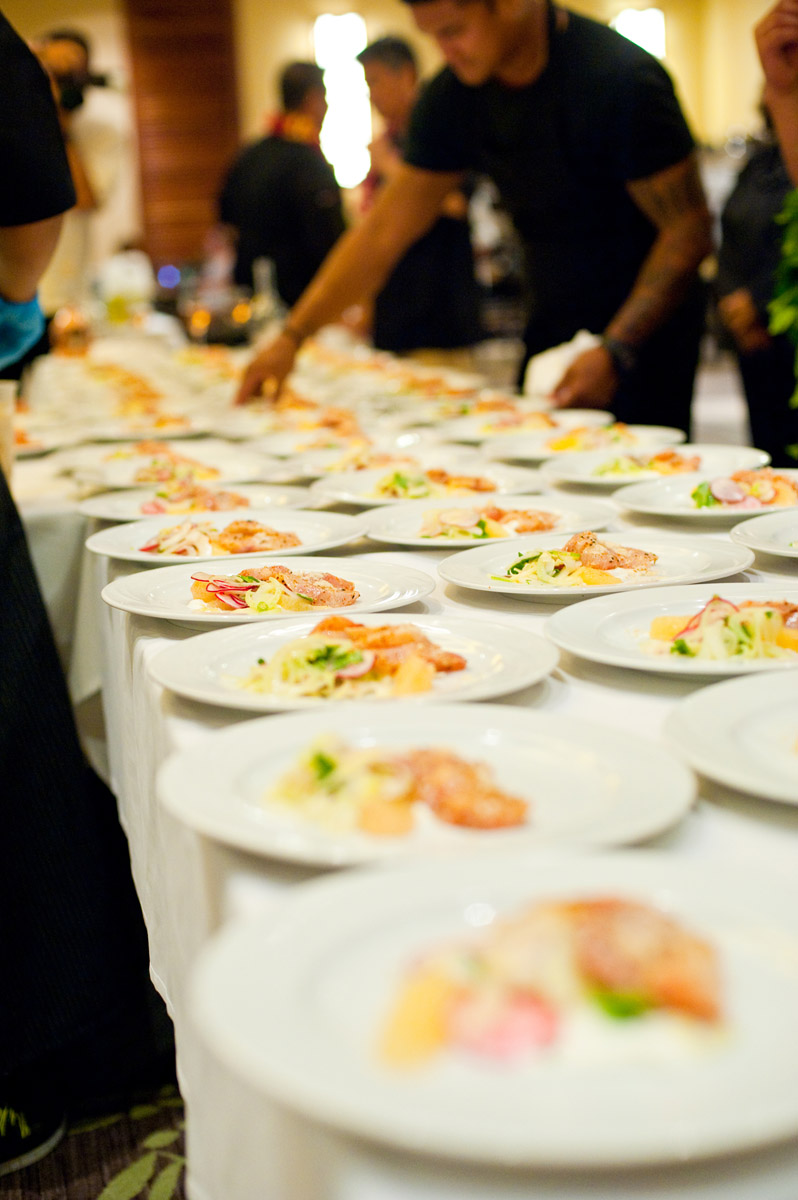
Dane Nakama, Hawaiʻi Food & Wine Festival [5]

For native Hawaiians, the luau has changed, too. It’s now something more of a potluck held among family and friends in someone’s backyard or a local park, celebrating high school graduations or birthdays. And yet commercial luaus have remained more or less the same over the past 30 years: peddling toned-down versions of traditional dishes, a sort of Hawaiian-Asian fusion.

Why is it so hard to find inspired authentic Hawaiian food at a luau? Chef Alan Wong, one of the chefs credited with the creation of the Hawaiian regional cuisine movement, points to tourism and hotels’ tendency to play it safe. That isn’t surprising, considering the more than 8.4 million visitors Hawaii received in 2014.

“The hotels who put on the luaus know their audience,” says Wong. “You will see dishes like salads and cold preparations and things that aren’t Hawaiian, because they think they aren’t going to like it otherwise. But I think the public and tourists really do want to go deeper; they’re more accepting now and more open. The problem is, people don’t know what Hawaiian food is. You know what cracks me up?  When you put a slice of pineapple on something, you can always call it Hawaiian. People put a slice of pineapple on a burger and they call it the Hawaiian burger. Hawaiian pizza. Cracks me up. Pineapple isn’t even originally from here.”

Dane Nakama, Hawaiʻi Food & Wine Festival [3]

At the end of the day, these kitschy affairs have very little to do with old Hawaiian cuisine. “Today’s luau that you might find in a hotel is definitely not a luau that you would have found 100 years ago,” Wong tells me. Those luaus have little to do with modern Hawaiian cuisine, as well.

That is, until now. With the help of some of the biggest names in the Hawaiian food scene, such as Roy Yamaguchi, Wong, and the state’s newest crop of young cooks, Hawaiian chefs are beginning to take on the culinary shortcomings of luau cuisine by creating something new and uniquely Hawaiian: the urban luau.

Photos by Dane Nakama, Hawaiʻi Food & Wine Festival.

“I think it’s really important to be having these type of luaus, which are modern and in an urban environment,” chef Yamaguchi tells me. He recently threw just such an event with Alan Wong and Denise Yamaguchi for Hawaii’s nonprofit Food & Wine Festival. “It’s tradition meeting the future and the modernization of Hawaii. I really want the rest of Hawaii to see what we can offer from an urban luau setting, where new ideas can come out.”

With a focus on Hawaiian produce, fish, and meat, as well as relying on local farmers, the urban luau interprets traditional flavors and ingredients while reflecting the modern cuisine of Hawaii. That may sound like a no-brainer, but considering that between 85 and 90 percent of the food in Hawaii is imported from the mainland, it’s actually revolutionary.

Dane Nakama, Hawaiʻi Food & Wine Festival [6]

Top Chef alum Lee Anne Wong, the mastermind behind Hale Ohuna and KoKo Head Café, refers to the urban luau as a reinvention of traditional Hawaiian dishes. “It has the ingredients and original flavor profile, just presented in a new and exciting manner,” she says. “What you see now also are these chefs working side by side with local fishermen, ranchers, farmers, and producers to showcase Hawaii’s unique products, building more sustainable businesses and practices. While this is commonplace on the mainland (the farm-to-table concept), it takes on a whole new meaning when you operate a business on a rock in the middle of the Pacific Ocean, and it is not only born out of the desire to support local economy but also out of necessity. We are returning to our roots, and combining modern techniques and technology to create a new style of aloha with our cuisine.”

Dane Nakama, Hawaiʻi Food & Wine Festival [2]

Sheldon Simeon, the chef at Migrant restaurant in Wailea, believes this new phase of Hawaiian cuisine is the result of the many phases Hawaiian food has gone through, in all its multicultural complexity. “What I do think has changed is the understanding of what exactly Hawaiian cuisine is—Hawaii is a crazy hodgepodge of flavors, all shaped by its history of settlers and immigrants.”

Like Simeon, chef Chris Kajioka of Hawaii’s highly anticipated CK restaurant thinks that the Hawaiian cuisine of the past has served as inspiration for the contemporary food movement. “I think the new generation of chefs is looking further back to ancient traditions and seeing what relevance they can play to now.”

Dane Nakama, Hawaiʻi Food & Wine Festival [7]

Because of that, the luau has finally been able to enter the modern world. Confronting the stagnant cuisine of a commercial luau—one of the last remaining relics of a time when Hawaii had little to offer in terms of a food scene—signifies the seriousness, vitality, and sheer magnitude of this latest food revolution.

And it will continue to spread—from LA’s growing poke obsession to the influx of Hawaiian restaurants in New York and San Francisco, and beyond.

Originally appeared on Refinery29

6 BBQ Hacks For An Epic 4th Of July

Independence Day is just around the corner — the time of the year where we get to let loose, enjoy some fireworks, don our best red, white, and blue duds, and celebrate our country’s birthday in the most American way we know how: a good ol’ fashioned BBQ! What we don’tsuggest for this weekend? Spending more time than absolutely necessary in the kitchen.

Whether you’re planning on hosting a group of friends, or just want to whip up some deliciously ‘merican munchies for you and your S.O., we’ve tapped two of our favorite L.A. food bloggers for easy recipes.

Ahead, Adrianna Adarme of A Cozy Kitchenand Julie Lee of Julie’s Kitchen have created a mouth-watering menu that can be prepped the night before and assembled in minutes. Think: Instagram-worthy drinks that can be mixed in no time, a side dish recipe that put chips and dip to shame, and a no-bake dessert you can make a day in advance.

Originally appeared on MUNCHIES

Eat These Flowers Off The Side Of The Road

Last fall, I was driving down a secluded canyon road in Malibu, California, when I spotted a vine full of lily pad-shaped leaves and the occasional orange flower crawling over a fallen tree just next to the road.

After stopping and getting out to inspect a little further, I saw this tree that was covered in what I thought was nasturtium, an edible vine of peppery leaves and bright flowers. And even better, since it was nearly winter, the vines had begun to die down for the season and only the saddest of its leaves, little shriveled flowers, and seed pods remained partially withered on the plant.

To be sure, I grabbed a leaf and a flower and put them in my mouth. When I wasn’t dead five hours later, I began counting down the days until summer.

Nasturtium is the lazy forager’s dream plant. If you’re looking for it, you can find it growing all over the West Coast: on the roadside, near river banks, and maybe even in your neighbor’s garden.

Beginning to bloom in late spring and early summer, nasturtium’s brightly colored orange, yellow, or red flowers (depending on the varietal) and circular, velvety leaves, are the marker of the start of Los Angeles’s summer and begin appearing on menus shortly thereafter. With a peppery, clean vegetal taste—something between watercress and arugula—nasturtium is a versatile plant whose leaves, flowers, and seed pods can be eaten raw, cooked, and prepared every other way in between.

Originally appeared on MUNCHIES

Wild Ginger Is the Designer Imposter of the Rhizome World

We’ve already tackled the delicious whorls known as fiddleheads, and the seasonal crack-like allium known as ramps (a.k.a. wild leeks). In the final installment of our spring foraging series, we’ve once again asked Steve Stacey—forager and director of the Local CFC, a community food center in Stratford, Ontario—for his thoughts on finding wild ginger, a rhizome that tastes and smells like the regular stuff but bears no relation to it.

Whether you’re searching for a local foraged version of this rhizome for your favorite ginger-based sex acts or want to up your forager ante by hunting down some of this buried treasure, here’s everything you need to know about finding, harvesting, and cooking up some wild ginger of your own.

Originally appeared on MUNCHIES

The Best Ramps Will Blow Your Head Off

Last week, we spoke with Steve Stacey, forager and director of the Local CFC—a community food center in Stratford, Ontario—who gave us some tips on foraging one of the finest alien tentacles known to man: the fiddlehead.

Stacey’s advice was so delicious that we checked back in with him for his thoughts on harvesting the lovely, potent, and much sought-after wild leek. Variously known as ramps, these short-lived alliums are basically the seasonal chef’s wet dream.

Originally appeared on MUNCHIES

Fiddleheads Are the Beyoncé of Foraged Foods

In the forager’s universe, there’s no time like right now. From fiddleheads and ramps to morels and wild ginger, spring is the season for sourcing wild food. To get some first-hand spring foraging knowledge of our own, we caught up with Steve Stacey, forager and director of the Local CFC—a community food center in Stratford, Ontario—to learn how to scour the earth for edible buried treasure.

We’re kicking off our foraging series with the queen diva—the Beyoncé, if you will—of springtime foraging. It’s a plant whose annoyingly short season is only made more finicky by its remote growing region and temperamental nature: the fiddlehead. 

Originally appeared on Refinery29

The Surprising Fashion Trend Taking Over The L.A. Food Scene

Over the past few years, Los Angeles has become a more exciting and important food city than ever before, from high quality local meats and produce to the multifaceted population of ethnic communities that make some of L.A.’s most delicious food. But, the latest trend is like nothing we’ve ever seen — and strangely reminiscent of our favorite fashion trend.

Let us explain. Besides a city-wide obsession with uni and a growing food court madness, there’s one trend that’s catching on with L.A.’s best spots: they’re coming in pairs. Some of our favorite restos are now opening up faster and more affordable counterparts to their acclaimed (and more expensive) spots, creating mini restaurant empires that provide every style of dining experience you could possibly want want.

Just like the high-low trend in fashion (a $500 Mansur Gavriel bag never looks better than when it’s paired with a $59 H&M dress), similar restaurant concepts have popped up all over our fair city. Chef Ludo Lefebvre has a casual French bistro named Petit Trois right next door to his ticketed Trois Mec. Connie and Ted’s casual seafood is the chill counterpart to Michael Cimarusti’s two Michelin starred Providence. And, most recently, Jon Shook and Vinny Dotolo’s newly opened Jon & Vinny’s casual red sauce Italian joint is in the same ‘hood as their more experimental and very elegant Animal.
PHOTO: COURTESY OF PETIT TROIS.

So, What’s The Deal?
“As a chef, you always want to come up with new and different concepts,” Lefebvre tells us, taking a break from his busy evening prep schedule.“Trois Mec is very unique and special. I wanted to provide a different kind of dining experience altogether to set them apart, not compete.” For him, opening up a French bistro was always a dream: “When the space right next to Trois Mec opened up, I knew it was meant to be.”

According to Lefebvre, accessibility wasn’t the only reason he had for opening up a faster, more affordable counterpart to Trois Mec. Instead, Petit Trois was a happy byproduct. Adding that while the close proximity (read: they share a wall) wasn’t his sole intention behind the restaurant, it is a defining concept of the bistro. “I have always dreamed of a little tiny French bistro in Los Angeles and, really, it was the space that dictated the concept,” he says.

Come One, Come All
“A great restaurant owner once told me, ‘Your restaurant is always a testament of where you’re at in your life.’ And, right now, we’re both in the stage of our lives where we’re parents who have young kids and wanted to create an environment for them to grow up in,” Jon Shook tells us of his newly opened, casual American-Italian spot with partner Vinny Dotolo, Jon & Vinny’s. “And, what better food than pizza and pasta, you know what I mean?”

Wanting to tap into something that’s comforting and reminiscent of the childhood experiences with food that first sparked their interest in cooking is definitely part of what’s driving this trend. Take Michael Cimarusti: With two Michelin stars under his belt for fine dining seafood restaurant Providence, he surprised everyone and opened Connie and Ted’s, the low-key New England style seafood restaurant modeled after east coast crab shacks. Naming the restaurant after his grandparents, who fostered a love and respect for fishing and family, Connie and Ted’s acts as a culinary homage to a much simpler time. Translation: It’s insanely delicious and the average diner is in jeans.

Foodie On A Budget
But, the most exciting part about this trend is that we now have the ability to experience the talent of these amazing chefs without breaking the bank.

Lefebvre describes the contrasting styles of spots as a complete version of his style of cooking:“The complementary aspect is like the ying to its yang — very different, but together make up the whole. At Trois Mec, you never know what you will find, our menu is constantly changing and I am always trying new things, learning new techniques, and finding new combinations,” he says. “At Petit Trois, the menu is much more simple and straightforward, like comfort food should be. Together, you get the full range of my cooking.”


Of course, opening up restaurants in high and low pairs isn’t exactly revolutionary. Shook reflects, “More chefs are doing casual projects…but it wasn’t necessarily public knowledge. I remember when I was in culinary school, back in Florida, there were guys that were great chefs doing taco places and hamburger joints.” So, if it’s not exactly new, why is this model trending and proving so successful for L.A.’s restaurant scene?

A lot of it comes down to cost, care, and mindset. “I think a lot of the reason why chefs are into opening up places that are a bit more casual is because of cost operations,” Shook says, pointing out that much of the cost of a fine dining restaurant goes towards things like service, glassware, tables, design, and other non-food related things. Essentially, a more casual place frees up money for high quality ingredients.“In fine dining, you’re essentially paying for the service and not necessarily the ingredients,” says Shook, “But, in all of our restaurants we buy the nicest stuff you can buy, bar none. Even the canned tomatoes that we’re using for the pizza, we’re buying the highest quality tomatoes you can buy. Picked in California, canned in California. As good, as if not better, than some of the ones fine dining restaurants are using.”


The Next Wave
Ready your appetite, because thankfully, this trend isn’t going anywhere. “I think the trend will continue for a long time,” Lefebvre says, “Chefs want to reach a broad spectrum of guests. And, they want different dining opportunities, whether it be from a food style standpoint or a different price point. I believe chefs will continue to push the restaurant styles and concepts they create. It’s exciting.”

It is exciting, and with Cimarusti’s forthcoming Cape Seafood and Provisions slated to open this summer, Mark Peel’s new Bombo stall (brand spanking new fish market stand) at Grand Central Market, Helen’s wine shop attached to Jon & Vinny’s, and Belcampo’s new restaurant to match their burgeoning Santa Monica butcher shop, it’s safe to say the trend is on the up and up.